
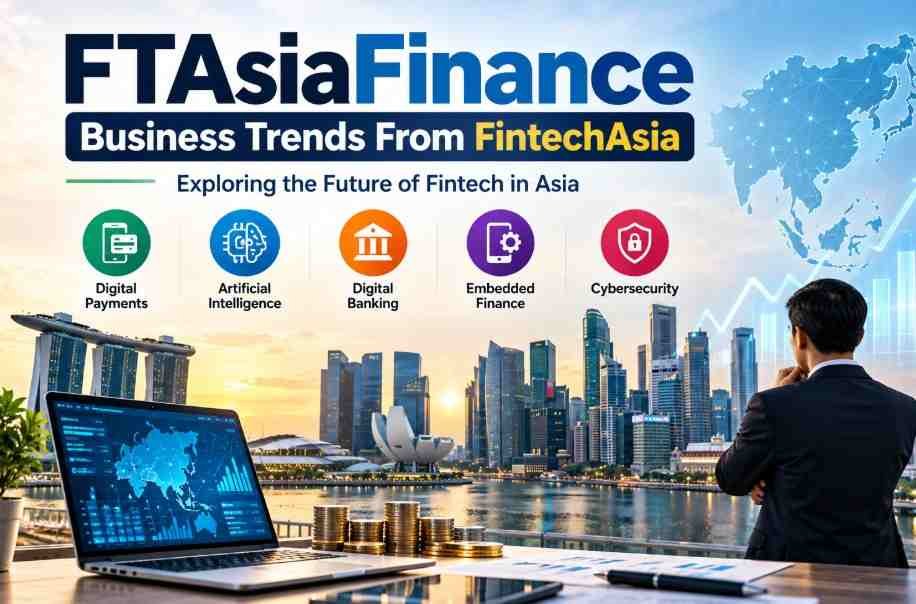
Financial generation is transforming how agencies manipulate money, method transactions, and hook up with clients. Across Asia, virtual banking, synthetic intelligence, and contemporary charge structures are growing possibilities for corporations of all sizes.
FTAsiaFinance Business Trends From FintechAsia explores trends influencing the monetary generation industry, specially in Asian markets. These include virtual payments, automated economic offerings, cybersecurity, and progressive business models.
For marketers, buyers, and business experts, expertise these changes is important for making knowledgeable choices.
This manual explains essential fintech traits in 2026, their business programs, capability benefits, and challenges.
What Is FTAsiaFinance Business Trends From FintechAsia?
FTAsiaFinance is a name appearing in online discussions approximately Asian monetary markets, fintech innovations, investment strategies, and commercial enterprise trends.
FintechAsia is associated with content material overlaying financial technology, digital banking, and emerging financial solutions.
The phrase commonly describes monetary era developments rather than a single independently proven studies file. A formal relationship between websites the usage of those names has no longer been honestly mounted.
The broader concern makes a speciality of how monetary innovations are changing banking, bills, investment control, and enterprise operations.
Countries along with India, Singapore, China, Indonesia, and Malaysia are essential markets for financial generation adoption.
Major Fintech Business Trends in 2026
1. Growth of Digital Payment Systems
Digital bills continue to transform monetary transactions throughout Asian markets.
Mobile wallets, QR-code payments, and instant bank transfers make transactions extra convenient for purchasers and businesses.
India’s Unified Payments Interface (UPI) is an instance of infrastructure assisting actual-time digital transactions.
Businesses can use these systems to enhance price comfort, preserve transaction data, and decrease dependence on coins.
However, transaction charges, service availability, and regulatory necessities range between companies.
2. Artificial Intelligence in Financial Services
Artificial intelligence is turning into more and more essential in banking and financial operations.
Financial establishments use AI-supported systems to method statistics, perceive uncommon transactions, and improve operational efficiency.
Common applications consist of:
- Fraud detection and transaction tracking.
- Automated customer service.
- Financial reporting and forecasting.
- Credit threat assessment.
- Document processing and statistics analysis.
- Compliance monitoring.
AI systems nevertheless require human oversight, mainly while decisions have an effect on customers or economic outcomes.
3. Expansion of Digital Banking
Digital banking lets in clients to access monetary offerings through mobile programs and on line systems.
Users can manage debts, transfer money, and screen transactions with out travelling bodily branches for many routine sports.
Digital-first economic companies may provide budgeting equipment and commercial enterprise banking offerings.
Their long-time period success depends on purchaser consider, economic stability, and regulatory compliance.
four. Increasing Adoption of Embedded Finance
Embedded finance permits organizations to integrate monetary offerings into non-economic platforms.
For instance, a web purchasing utility might also offer payment processing or financing alternatives all through checkout.
This technique can improve convenience and create extra revenue opportunities.
However, organizations need to work with accurately authorized monetary carriers and comply with relevant regulations.
5. Growing Importance of Cybersecurity
As virtual financial services extend, organizations face increasing dangers related to fraud, records breaches, and unauthorized get admission to.
Organizations are investing in more potent authentication, encryption, tracking systems, and employee education.
Effective cybersecurity facilitates protect sensitive statistics and hold customer confidence.
Comparison of Important Fintech Trends
| Fintech Trend | Main Application | Business Benefit |
|---|---|---|
| Digital Payments | Electronic transactions | Convenient price processing |
| Artificial Intelligence | Financial automation | Improved operational efficiency |
| Digital Banking | Online banking services | Easier economic get entry to |
| Embedded Finance | Integrated financial offerings | Better purchaser comfort |
| Open Banking | Authorized data sharing | Improved connectivity |
| Cybersecurity | Information safety | Reduced protection dangers |
| Blockchain | Distributed facts | New monetary infrastructure |
| Financial Analytics | Performance tracking | Better financial planning |
These technology provide exceptional advantages depending on commercial enterprise requirements.
How FTAsiaFinance Business Trends From FintechAsia Affect Businesses
Financial era is converting how companies take care of everyday operations.
Small corporations can use digital fee systems to acquire customer payments and keep accurate transaction histories.
Larger agencies may additionally adopt computerized accounting, monetary analytics, and included banking answers.
International organizations can also explore cross-border fee services to control foreign places transactions.
Potential blessings consist of:
- Faster financial techniques.
- Improved economic recordkeeping.
- Better consumer charge reports.
- Reduced repetitive administrative paintings.
- Greater visibility into commercial enterprise overall performance.
- Access to new digital economic services.
Actual outcomes depend on implementation fees, protection, and operational necessities.
Investment Opportunities in Asian Fintech
Financial generation creates possibilities for entrepreneurs and traders interested by innovative enterprise models.
Potential investment regions consist of digital payments, regulatory generation, cybersecurity, financial control software, and go-border transaction infrastructure.
However, fintech investments contain considerable uncertainty.
Investors have to look at monetary overall performance, client call for, opposition, regulatory compliance, and business sustainability before committing capital.
Rapid technology adoption does now not robotically assure profitability.
Challenges Facing Financial Technology Companies
Despite persevered innovation, fintech businesses face numerous limitations.
Regulatory Requirements
Financial carrier vendors need to follow relevant banking, privacy, and patron protection rules.
Security Concerns
Cyberattacks and financial fraud can harm customer consider and create operational losses.
Integration Costs
Connecting new technology with current systems can also require giant investment.
Customer Confidence
Financial structures should reveal reliability, transparency, and accountable records managing.
Addressing these demanding situations is vital for sustainable growth.
How Businesses Can Prepare for Fintech Changes
Organizations can gain from comparing emerging technologies strategically.
Start through reviewing existing economic strategies and figuring out areas in which automation ought to deliver measurable price.
Compare vendors primarily based on reliability, pricing, technical compatibility, and customer support.
Businesses need to additionally educate employees, establish cybersecurity techniques, and display effects after implementation.
Adopting era due to the fact it is popular is hardly ever a enough business method.
Future of Fintech in Asia
Financial technology is predicted to hold evolving through synthetic intelligence, linked price networks, and advanced digital services.
Businesses are exploring smarter monetary tools, greater handy fee methods, and automatic reporting systems.
However, a hit innovation calls for careful hazard control and strong consumer safety.
The maximum valuable technologies could be people who clear up genuine troubles even as preserving reliability and transparency.
Frequently Asked Questions
1. What does FTAsiaFinance discuss with?
FTAsiaFinance appears in on-line content material discussing economic technology, Asian markets, enterprise strategies, and investment-related developments.
2. What are the most important fintech tendencies in 2026?
Important developments include synthetic intelligence, digital banking, on the spot bills, embedded finance, and cybersecurity.
3. How can fintech help small corporations?
Financial era can simplify payments, enhance accounting techniques, and assist monetary planning.
4. Is fintech investment absolutely safe?
No. Fintech investments contain financial, operational, regulatory, and market risks.
5. Why is Asia crucial for fintech improvement?
Asia carries main digital price ecosystems, developing generation markets, and diverse possibilities for economic innovation.
Conclusion
FTAsiaFinance Business Trends From FintechAsia highlights vital tendencies shaping contemporary monetary services across Asian markets.
Artificial intelligence, virtual payments, embedded finance, cybersecurity, and virtual banking are influencing how groups perform.
Companies that understand these tendencies can perceive useful technologies, improve financial strategies, and compare rising opportunities.
However, successful adoption calls for dependable records, economic discipline, safety features, and cautious business making plans.
FTAsiaFinance Business: Features, Benefits, Financial Trends & Complete Guide

Through his writing, Kabir focuses on delivering informative perspectives that help entrepreneurs, professionals, and business enthusiasts stay updated with important developments and make better-informed decisions.
At Business Prime Time, Kabir continues to explore emerging opportunities, industry trends, and ideas shaping the future of business.
- RoarLeveraging Business InfoGuide by RipRoar: Smart Strategies for Business - November 3, 2026
- Management Guide EWMagWork: Smart Strategies for Better Team Productivity - October 31, 2026
- Peter McMahon Net Worth: Income, Career, Business & Dana Perino’s Husband - October 30, 2026
[…] FTAsiaFinance Business Trends From FintechAsia: Top Financial Technology Trends […]