
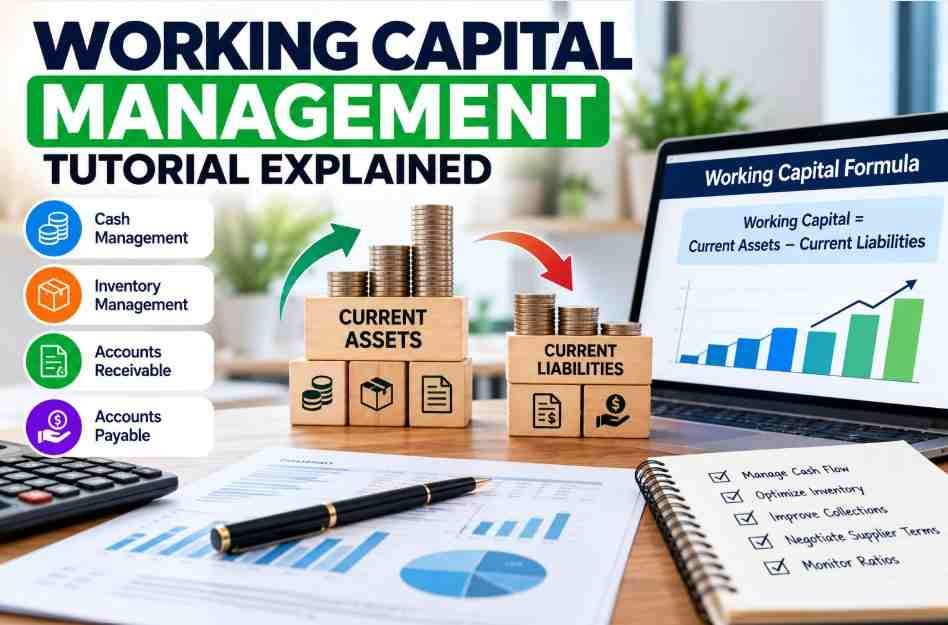
Managing commercial enterprise finances is essential for preserving smooth operations and attaining lengthy-term success. Every company desires sufficient price range to pay providers, buy inventory, cowl salaries, and take care of day by day expenses.
This operating capital control academic defined manual helps business owners, students, and finance professionals understand how agencies control brief-term property and liabilities.
Effective running capital management improves liquidity, supports operational efficiency, and reduces needless monetary pressure. Even worthwhile businesses can enjoy coins shortages while payments and fees are poorly controlled.
This article covers the meaning, formulation, additives, examples, benefits, and realistic strategies concerned in coping with working capital.
What Is Working Capital Management?
Working capital control is the method of dealing with a corporation’s cutting-edge property and present day liabilities to keep sufficient price range for every day commercial enterprise operations.
Current property encompass coins, inventory, money owed receivable, and other assets anticipated to emerge as coins inside 365 days or the regular working cycle.
Current liabilities encompass bills payable, quick-term borrowings, and other responsibilities due inside the equal period.
The number one goal is keeping liquidity while averting excessive investment in stock or unpaid customer invoices.
Working Capital Formula With Example
Working capital is calculated the usage of the subsequent components:
[ \text{Working Capital} = \text{Current Assets} – \text{Current Liabilities} ]
Suppose a company has the following monetary data.
| Financial Component | Amount |
|---|---|
| Cash | ₹2,00,000 |
| Accounts Receivable | ₹three,00,000 |
| Inventory | ₹five,00,000 |
| Total Current Assets | ₹10,00,000 |
| Accounts Payable | ₹three,00,000 |
| Short-Term Loans | ₹2,00,000 |
| Total Current Liabilities | ₹5,00,000 |
Calculation:
Working Capital = ₹10,00,000 − ₹five,00,000
Working Capital = ₹5,00,000
The organization has ₹five,00,000 extra in cutting-edge assets than present day liabilities.
However, advantageous operating capital does now not assure instantaneous cash availability due to the fact stock and receivables may take time to convert into money.
Main Components of Working Capital Management
1. Cash Management
Cash management includes tracking incoming bills and outgoing charges.
Businesses must preserve enough coins for salaries, hire, utilities, and provider bills.
Regular coins waft forecasting enables prevent surprising shortages.
2. Inventory Management
Inventory includes products and materials held for production or sale.
Excess stock will increase storage prices and ties up budget.
Insufficient inventory may additionally motive neglected sales and production delays.
Businesses need to preserve stock stages based totally on sensible customer call for.
3. Accounts Receivable Management
Accounts receivable represents money owed through clients who buy goods or services on credit score.
Clear payment terms and timely collection tactics help improve cash glide.
4. Accounts Payable Management
Accounts payable represents quantities owed to providers.
Businesses must time table bills cautiously even as preserving professional dealer relationships.
Agreed charge terms can assist groups manage short-time period liquidity.
Types of Working Capital
| Type | Meaning |
|---|---|
| Gross Working Capital | Total cutting-edge property |
| Net Working Capital | Current assets minus cutting-edge liabilities |
| Permanent Working Capital | Minimum operating capital required |
| Temporary Working Capital | Additional funds for seasonal wishes |
| Positive Working Capital | Current belongings exceed modern-day liabilities |
| Negative Working Capital | Current liabilities exceed modern belongings |
Different industries require distinctive operating capital stages depending on their working cycles.
Importance of Working Capital Management
Understanding operating capital management academic explained principles helps groups understand the significance of economic planning.
Major blessings consist of:
- Improved liquidity: Supports well timed payment of duties.
- Better coins drift: Helps manage incoming and outgoing finances.
- Operational efficiency: Improves stock and fee management.
- Reduced borrowing: May decrease dependence on pricey financing.
- Financial balance: Helps groups control surprising charges.
- Growth possibilities: Supports deliberate investments and growth.
Effective control balances enough liquidity with green aid usage.
What Is the Cash Conversion Cycle?
The coins conversion cycle measures how long a agency takes to transform funding in inventory and receivables into coins, after accounting for provider payment timing.
Its formulation is:
[ \text{CCC} = \text{DIO} + \text{DSO} – \text{DPO} ]
Where DIO means Days Inventory Outstanding, DSO manner Days Sales Outstanding, and DPO way Days Payable Outstanding.
Example of Cash Conversion Cycle
| Financial Metric | Days |
|---|---|
| Inventory Holding Period | 45 |
| Customer Collection Period | 30 |
| Supplier Payment Period | 25 |
Cash Conversion Cycle = 45 + 30 − 25
CCC = 50 days
This indicates that about 50 days bypass between coins payments for working inputs and coins series from customers.
Best Working Capital Management Strategies
Businesses can enhance monetary efficiency through practical techniques.
Improve Cash Flow Forecasting
Prepare regular forecasts protecting predicted receipts and upcoming charges.
Reduce Excess Inventory
Monitor demand and pick out gradual-shifting merchandise to keep away from unnecessary inventory accumulation.
Accelerate Customer Collections
Send invoices right away and observe up professionally on late payments.
Negotiate Supplier Payment Terms
Agree on charge schedules that assist liquidity with out detrimental dealer relationships.
Monitor Financial Ratios
Review liquidity and operational performance signs frequently.
Control Short-Term Borrowing
Evaluate financing fees cautiously earlier than taking extra short-term loans.
Important Working Capital Ratios
| Ratio | Formula |
|---|---|
| Current Ratio | Current Assets ÷ Current Liabilities |
| Quick Ratio | (Current Assets − Inventory − Prepaid Expenses) ÷ Current Liabilities |
| Inventory Turnover | Cost of Goods Sold ÷ Average Inventory |
| Receivables Turnover | Net Credit Sales ÷ Average Receivables |
| Working Capital Turnover | Net Sales ÷ Average Working Capital |
These ratios must be evaluated alongside industry benchmarks and historic financial performance.
Common Mistakes Businesses Should Avoid
Poor monetary choices can create liquidity issues.
Common mistakes consist of:
- Maintaining needless inventory.
- Ignoring past due client bills.
- Failing to forecast coins requirements.
- Offering credit score without right assessment.
- Depending excessively on brief-term borrowing.
- Delaying provider payments without settlement.
Regular monetary critiques assist agencies perceive these problems earlier than they end up severe.
Frequently Asked Questions
1. What is working capital management in easy terms?
It entails dealing with cash, inventory, receivables, and quick-term obligations to support daily enterprise operations.
2. What is the method for running capital?
Working Capital = Current Assets − Current Liabilities.
3. Why is operating capital important?
It helps companies hold liquidity, cover running prices, and control monetary duties.
4. Is negative running capital continually dangerous?
No. Some organizations operate efficiently with terrible working capital because customers pay earlier than suppliers require price.
five. How can businesses enhance working capital?
Companies can improve collections, optimize inventory, forecast cash waft, and negotiate suitable price terms.
Conclusion
This Working Capital Management Tutorial Explained manual demonstrates how businesses can control brief-term assets and liabilities efficaciously.
Working capital management helps liquidity, operational stability, efficient stock manage, and timely economic payments.
Companies have to regularly review coins float, reveal monetary ratios, and enhance collection strategies.
A disciplined operating capital method can strengthen economic resilience and support sustainable commercial enterprise boom.
Growth Navigate Startup Tools: The Intelligent Guidebook For Growing Your Business In 2026

Through his writing, Kabir focuses on delivering informative perspectives that help entrepreneurs, professionals, and business enthusiasts stay updated with important developments and make better-informed decisions.
At Business Prime Time, Kabir continues to explore emerging opportunities, industry trends, and ideas shaping the future of business.
- Management Guide EWMagWork: Smart Strategies for Better Team Productivity - October 31, 2026
- Peter McMahon Net Worth: Income, Career, Business & Dana Perino’s Husband - October 30, 2026
- PedroVazPaulo Business Consultant: Services, Benefits & Growth Strategies - October 30, 2026