
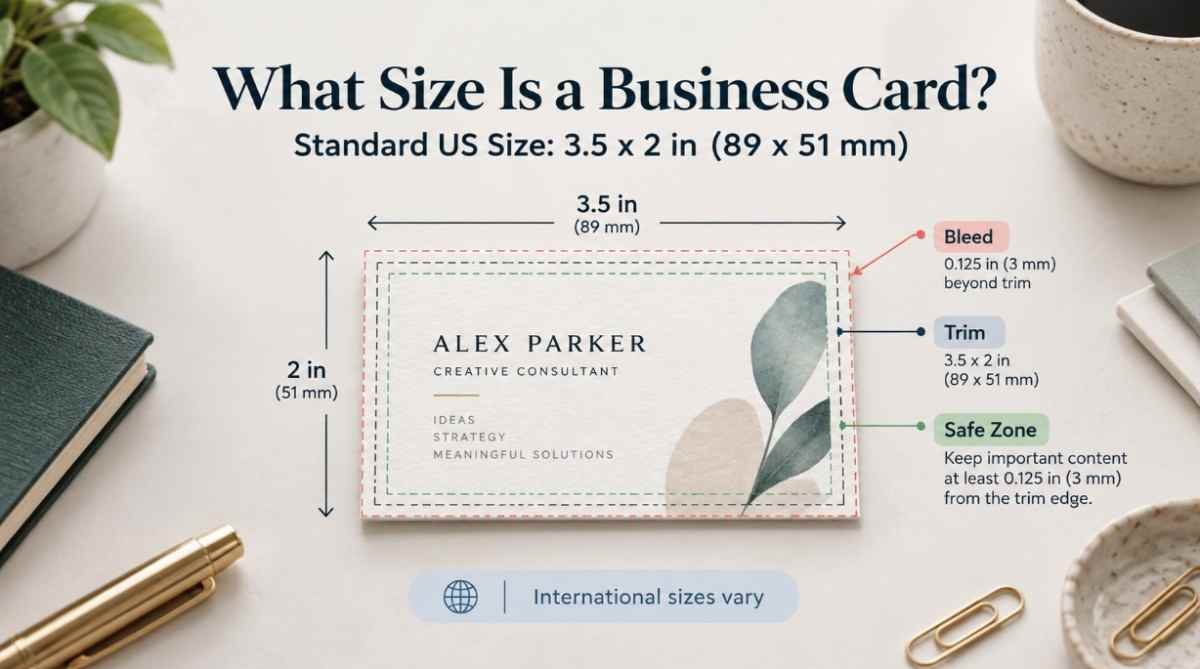
Despite the small size, a business card serves as an efficient tool to develop professional relationships. Your business card is often the first physical manifestation of your brand that a future client, partner or customer receives. This means a high-quality looking and feeling card, which fits nicely in any wallet or cardholder can be very impressive.
Before creating a design or sending files for printing, many designers, business owners and marketers tend to ask what size is a business card. Selecting the right dimensions is for design web because product sizes are a device that can influence usability, printing costs, and also how well your brand looks.
This guide will cover the commonly used business card sizes, where these variations are used in addition to print setup requirements, with several creative alternatives to use when designing your optimal business card design 2026.
US Standard Business Card Size
The largest accepted American and Canadian card size is:
| Measurement | Standard Size |
|---|---|
| Inches | 3.5 x 2 inches |
| Millimeters | 89 x 51 mm |
| Centimeters | 8.9 x 5.1 cm |
Standard Size
This is the most common size because it gives enough area for important information and is tiny enough to fit in any wallet even while holding key data. This format is already optimized by most professional printers, design tools, and templates.
Common Contents of Business Card Usually includes:
-
Company logo
-
Brand name
-
Person’s name
-
Job title
-
Phone number
-
Email address
-
Website URL
-
Social media handles
-
QR code
The aim is to share useful data, without making it feel busy.
Why Business Card Size Matters
One of the features that determines a card’s usability and the way it is identified as a brand is its dimensions. An appropriately sized card is more useful in terms of storage, portability, and memorability.
High-level benefits for using standard dimension is as follows:
-
Improved portability — While standard cards can easily fit into wallets, purses, and cardholders.
-
Professional look: Familiar specs imply familiarity and predictability.
-
Low cost print: Sizes are standard hence making it easier to produce and slightly less wastage.
-
Improved design balance: enough space to include text, graphics and white space.
Your average business card isn’t a name and number sheet. This is a powerful branding tool – compact version of your own company identity.
International Sizes of Business Cards
Different countries have different standard business card sizes. Traditions of press and preferred sizes differ across distinct areas.
| Country/Region | Inches | Millimeters |
|---|---|---|
| United States & Canada | 3.5 x 2 in | 89 x 51 mm |
| Europe & UK | 3.35 x 2.17 in | 85 x 55 mm |
| Australia | 3.54 x 2.17 in | 90 x 55 mm |
| Japan | 3.58 x 2.17 in | 91 x 55 mm |
| India | 3.54 x 2.17 in | 90 x 55 mm |
But in case your small business operates internationally, the proper regional format will help you higher these customers utilizing native wallets, cardholders or enterprise practices.
Business Card vs Credit Card
People often say that business cards are like credit cards, because both are meant to be carried every day.
Credit cards generally are around the size of a credit card:
-
3.375 x 2.125 inches
-
85.60 x 53.98 mm
A business card is a little bit fancier and slightly wider, but will have almost the same compact format.
This similarity is intentional. Both formats easily fit in wallets or organizers.
All About Bleed & Safe Area for Printing
This will not make you a profession with perfect design by just alerting to the final card size. Bleed is extra space needed for print files
Bleed helps to cut the card properly with no white edges after printing.
For a standard business card:
Final size:
3.5 x 2 inches
Design file with bleed:
Around 3.75 x 2.25 inches
Important Print Areas
Bleed Area
So the bleed area is larger than where the cutting line will be finalized. This area should continue with a particular background color, image or pattern.
Trim Line
The trim line indicates to where the printer will ultimately cut the final card.
Safe Zone
Crucial things should remain inside the safe zone.
Do not place these elements near the edges:
-
Text
-
Logos
-
Contact details
-
QR codes
Recommended safe margin:
Around 0.125 inches (3 mm)
Bleed and margins eliminate cutting problems and ensure a professional looking without any mess.
Popular Alternative Business Card Sizes
Although common dimensions are still the most popular, many brands opt for special formats to make a lasting impression.
Square Business Cards
This is why square cards became a trend for creative businesses, the unique and modern look of it are just great.
Common users include:
-
Photographers
-
Designers
-
Fashion brands
-
Creative agencies
Advantages:
-
Eye-catching shape
-
Unique presentation
-
Strong visual impact
Mini Business Cards
Mini cards are the small versions made for low-key branding.
They work well for:
-
Personal brands
-
Artists
-
Boutique businesses
-
Product packaging
Still, the boundary on area demands almost meticulous design decisions.
Folded Business Cards
Folded cards offer more space for details.
These are helpful to enterprises that need:
-
Service lists
-
Appointment details
-
Menus
-
Instructions
Types of Folded Formats — e.g. Restaurant Menus, Salons and Healthcare Providers often use them
How to Create an Effective Business Card
While getting the right dimensions does matter, the design determines how good your card will perform.
Follow these best practices:
-
Use high-resolution images and logos
-
Keep fonts readable
-
Avoid adding too much information
-
Maintain enough white space
-
Pair colors according to your brand identity
-
Use professional printing materials
-
QR Code — add it only when there is real benefit
A clear and simple design generally works better than an information-packed card.
Digital Business Cards and The New Age of Networking
While digital networking has multiplied, there are still many scenarios in which our need for physical business cards come into play.
Contemporary businesses commonly use printed cards with:
-
QR codes
-
NFC technology
-
Digital profiles
-
Online portfolios
By combining the best of both worlds you give people an opportunity to transfer/ exchange physical cards whilst giving contacts immediate access online.
Despite digital alternatives to business cards, knowing the size of a business card is still important since printed cards are still used in meetings, conferences, trade shows and networking events.
Frequently Asked Questions
What Size is a Standard Business Card? (Infographic inside)
The common business card size in the US is 89 x 51 mm, or 3.5 x 2 inches. Jukebox Print
Canva business card design size
For a standard design:
-
Width: 3.5 inches
-
Height: 2 inches
-
Resolution: 300 DPI
-
Add 0.125-inch bleed
Is a Business Card the Same Size in the World?
No. Different standards are used in different countries. When it comes to the physical size, a standard ID in US is 3.5 x 2 inches and many countries in Europe accept them in 85 x 55 mm size. Canva
Will a custom size work for my business card?
Yes. Square, mini, oversized or folded formats are recommended based on both the industry a brand is in and design goals.
Final Thoughts
Learning the appropriate size make sure that your business card looks more presentable, prints well and represents your brand properly. The 3.5 x 2 inch (89 x51 mm) is still the safest bet for most businesses because it offers a good balance of usability, cost and design flexibility within US business cards formats.
The optimal size, though, varies based on your target audience, geographic footprint and branding plan. Be it a conventional or creative format, always design with bleed, safe zones and print production specifications in mind.
A business card that not only fits in the palm of your hand but can also have an impact well beyond this tiny physical space.
What Is Business Casual Woman? Understanding the Modern Workplace Style

Through his writing, Kabir focuses on delivering informative perspectives that help entrepreneurs, professionals, and business enthusiasts stay updated with important developments and make better-informed decisions.
At Business Prime Time, Kabir continues to explore emerging opportunities, industry trends, and ideas shaping the future of business.
- Management Guide EWMagWork: Smart Strategies for Better Team Productivity - October 31, 2026
- Peter McMahon Net Worth: Income, Career, Business & Dana Perino’s Husband - October 30, 2026
- PedroVazPaulo Business Consultant: Services, Benefits & Growth Strategies - October 30, 2026